
Cautious Britons are saving at a record rate, as the stark reality of economic contraction begins to crystallize in the public consciousness.
Deposits held by households jumped a record £25.6 billion in May, adding to a significant savings stockpile accrued in the preceding months, latest Bank of England data has revealed.
Concomitantly, mortgage approvals declined to a record low of just 9,300 in May, (for context, UK mortgage approvals average 60,000 to 70,000 a month) while consumers continued to reduce outstanding debts, paying down £4.6 billion in credit card and other lending during May, following an unprecedented £7.4 billion the previous month.
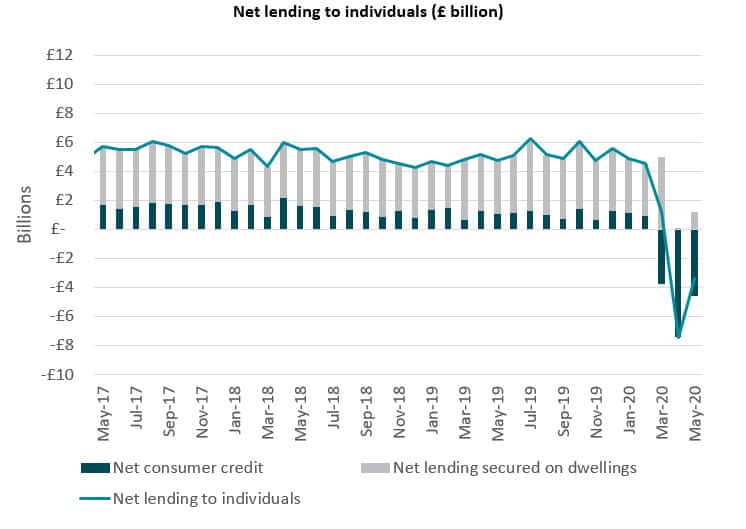
Although over 9 million people are currently furloughed, the risk of substantial job losses over the Autumn/Winter period, as the Job Retention Scheme is wound down, has prompted the logical, if economically deleterious expansion in precautionary saving and a concurrent collapse in expenditure. The paradox of thrift made manifest.
Overall consumer spending fell by 26.7% year-on-year in May. In-store spending has suffered a dramatic decline of 45.3% year-on-year, compared to just 0.1% for online purchasing. Revealingly, while some consumer activity has migrated online, the benefit appears superficial, as the net result has been a consequential collapse in expenditure.
Forecasters of an openly optimistic persuasion advocate the hypothesis of pent-up demand delivering a strong, potentially V shaped recovery, as lockdown restrictions continue to be eased. Perhaps consumers in the upper income percentile, who have naturally accrued liquid capital while expenditures have been restricted, may act upon delayed purchases, but with median household disposable income at just £29,400 and unsecured debt per household at a record high of £14,540, the bleak economic outlook appears to be a severe restraining factor.
As I wrote in these page in early May, https://broad-spectrum.org/2020/05/06/who-will-lead-the-charge-in-the-promised-recovery/, an already heavily indebted consumer, now faced with the worst unemployment forecasts in over 40 years, is in a lamentably weak position to spearhead the oft posited consumer lead recovery.
Central Bank interventions have been monumental in scale, but the funds created by QE are financing record government deficits incurred in lockdown mitigation, not providing any direct stimulus to broader economic activity.
As the service sector accounts for in excess of 80% of the UK economy, cautious, distressed, indebted and potentially unemployed consumers do not constitute a sold foundation for recovery.

Stephen Cherry. 29th June 2020.
 BROAD SPECTRUM
Thanks – an interesting analysis. I wonder if Student Debt which has previously been a significant component of unsecured household debts (I’m not sure of the percentage in the latest figures) should be considered separately due to the payment terms. This doesn’t change the main point here relating to increased saving, but it adjusts the picture a little – as there is a certain inevitability to student debt increasing as the fee ceiling gradually increases at universities.
LikeLike